IT & Science
The launch planned for Oct. 7 aims for South Korea's first clustered-satellite deployment. Rocket success, satellite separation and operational success are not the same thing.
Information cutoff: 2026-09-30 22:25 KST
Prepared: 2026-09-30 22:37 KST
AI-assisted public-source analysis · Private draft · Awaiting human editorial review
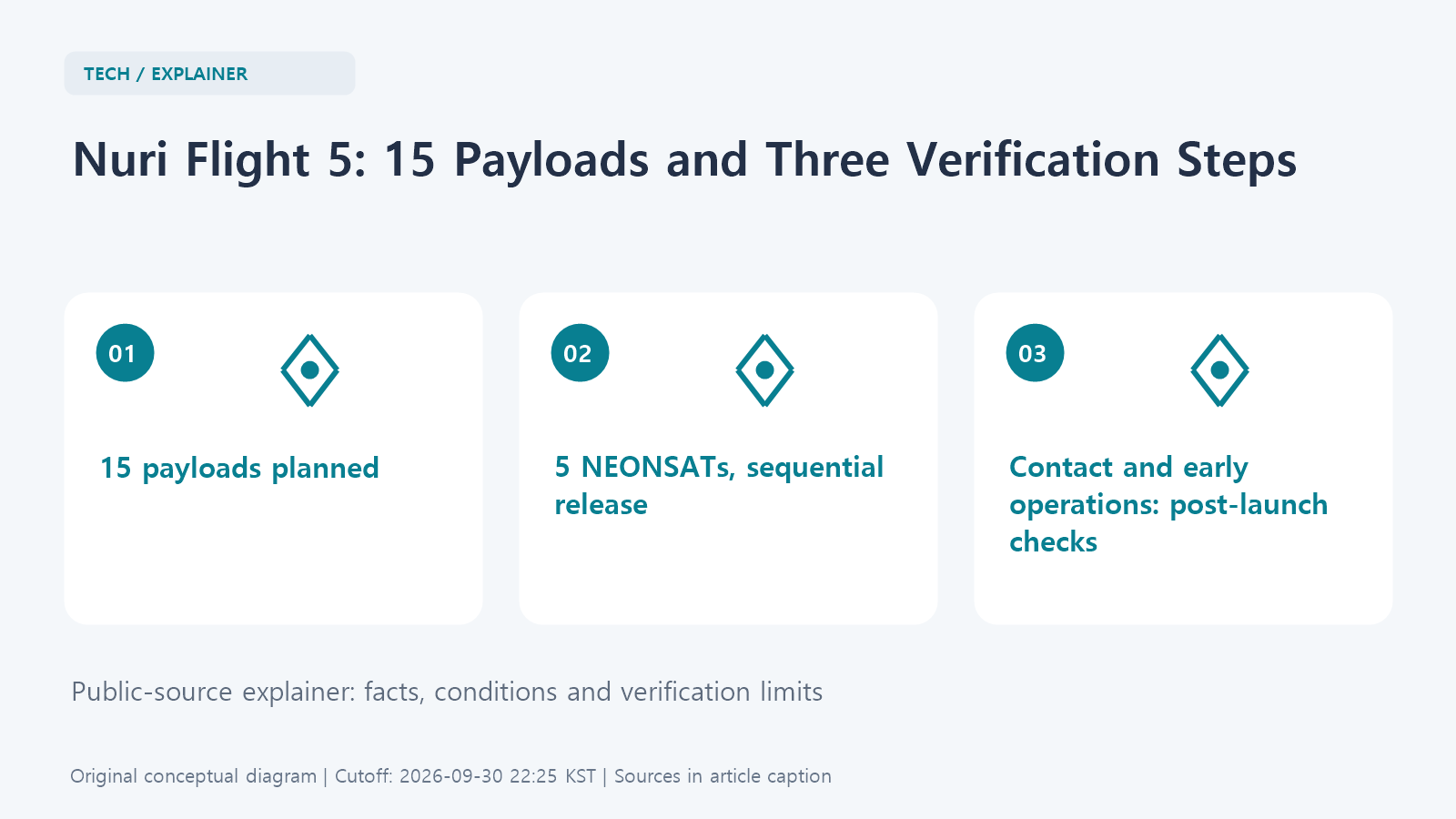
For the launch planned on Oct. 7. Payload count, physical separation and satellite operation are separate verification stages.
KARI / Korea AeroSpace Administration · 누리호 5차, 10월 7일 발사 · Korea AeroSpace Administration · 누리호 5차 발사, 국내 최초 군집위성 시대 연다 · KARI / Korea AeroSpace Administration · 누리호 4차 발사 성공으로 뉴스페이스 시대 개막 · Korea AeroSpace Administration · 누리호 4차 발사 부탑재위성 교신 종합결과
Visual: original explanatory diagram. No third-party photograph or chart reproduced.
At a glance
- Nuri's fifth flight is planned for Oct.
7 with five NEONSAT spacecraft and 10 CubeSats, 15 satellites in all. - The key issue is not only the count, but a procedure designed to release five NEONSATs 35 to 40 seconds apart in different directions.
- After launch, target-orbit insertion, individual separation, ground contact and early operations must be verified separately.
At D-7, assembly was complete, but liftoff was still a plan
As of Sept.
30, Nuri's fifth vehicle had reportedly completed assembly of its first, second and third stages.
KBS and DongA Science each reported on KARI-released assembly material.
Under the official plan, final checks run through Oct.
5, followed by transfer to the launch pad on Oct.
6 if no issue is found.
The planned launch date is Oct.
7, with Oct.
8 through 14 reserved as a backup period.
The final time will be set on launch day.
Evidence: KARI / Korea AeroSpace Administration · 누리호 5차, 10월 7일 발사 · Korea AeroSpace Administration · 누리호 5차 발사, 국내 최초 군집위성 시대 연다 · KBS News · 누리호 5차 발사 D-7, 발사 준비 ‘착착’ · DongA Science · 위성 15기 싣는 누리호…5차 발사 앞두고 결합 현장 공개
The 15-satellite figure is a manifest of five primary and 10 secondary payloads
The manifest consists of five NEONSAT spacecraft, numbers 2 through 6, and 10 CubeSats.
NEONSAT is intended to acquire imagery for national security and disaster responses including fires and floods.
KASA listed examples of secondary-payload missions: domestic-component verification in space, low-Earth-orbit environment research, monitoring currents carrying marine debris off Jeju, and analysis of fine-dust trends and sources.
Evidence: Korea AeroSpace Administration · 누리호 5차 발사, 국내 최초 군집위성 시대 연다
The first hurdle is sequential deployment of five NEONSATs
Public-source analysis
The new challenge is to release five NEONSATs with the same mission 35 to 40 seconds apart and in different directions.
KASA says a low-shock separation device has been applied.
The record figure of 15 payloads is therefore not simply a count of objects sent up together.
It is also a test of releasing multiple satellites as intended.
Evidence: Korea AeroSpace Administration · 누리호 5차 발사, 국내 최초 군집위성 시대 연다 · The Korea Times / Yonhap · Space agency chief says preparations for 5th Nuri launch on track
Successful separation and successful operation are different verdicts
Limits of verification
For the launch vehicle, success is assessed by whether payloads are separated under the target orbital conditions.
From the satellite perspective, each spacecraft must also transmit, communicate with a ground station, complete early checks and carry out its intended mission.
As of the night of Sept.
30, the fifth flight had passed through none of those stages.
The figure 15 is a planned payload count, not an advance declaration that 15 satellites will operate successfully.
Evidence: Korea AeroSpace Administration · 누리호 5차 발사, 국내 최초 군집위성 시대 연다 · KARI / Korea AeroSpace Administration · 누리호 4차 발사 성공으로 뉴스페이스 시대 개막 · Korea AeroSpace Administration · 누리호 4차 발사 부탑재위성 교신 종합결과
Against the fourth flight, only separation count is directly comparable
Public-source analysis
The initial official result for the fourth flight said it separated 13 satellites: one primary payload and 12 CubeSats.
The fifth flight's planned manifest of 15 is two higher under that payload-separation count.
But a later report said nine of the fourth flight's 12 secondary satellites had made contact, while attempts continued for three.
That follow-up figure uses a different criterion from the 13 separations, so it cannot be turned into a simple success-rate comparison before the fifth flight launches.
Evidence: Korea AeroSpace Administration · 누리호 5차 발사, 국내 최초 군집위성 시대 연다 · KARI / Korea AeroSpace Administration · 누리호 4차 발사 성공으로 뉴스페이스 시대 개막 · Korea AeroSpace Administration · 누리호 4차 발사 부탑재위성 교신 종합결과
Sources and references
Primary sources
- KARI / Korea AeroSpace Administration · 누리호 5차, 10월 7일 발사
2026-08-27 - Korea AeroSpace Administration · 누리호 5차 발사, 국내 최초 군집위성 시대 연다
2026-09-15 - KARI / Korea AeroSpace Administration · 누리호 4차 발사 성공으로 뉴스페이스 시대 개막
2025-11-27 - Korea AeroSpace Administration · 누리호 4차 발사 부탑재위성 교신 종합결과
2025-12-02
News reports
- KBS News · 누리호 5차 발사 D-7, 발사 준비 ‘착착’
2026-09-30 - The Korea Times / Yonhap · Space agency chief says preparations for 5th Nuri launch on track
2026-09-30T12:05:00+09:00 - DongA Science · 위성 15기 싣는 누리호…5차 발사 앞두고 결합 현장 공개
2026-09-30